
Low Rise is Back: How the Return of 2000s Skinny is a Recession and Oppression Indicator
TRIGGER WARNING: This article discusses diet culture, body image, disordered eating, and eating disorders including orthorexia and anorexia. It references specific cultural moments and media coverage that may be distressing to readers with a history of disordered eating. If you are currently struggling, the Alliance for Eating Disorders Helpline can be reached at 1-866-662-1235.
We don't really have that much free will. I mean, we could conceivably do whatever we want. But we won't. Why?
Antonio Gramsci called it hegemony, the process by which dominant ideology embeds itself so deeply into daily life that it begins to feel like common sense. Like personal preference. Like a choice you made yourself.
So when the waistlines start receding, and you catch yourself googling how to lose 20 pounds by May, how much of that is free thought? You can't see a photo of a red carpet darling in 2026 without an exposed clavicle and sternum. Of the nearly 10,000 looks during fashion weeks around the world, 97% were worn by models under size 4 (US). But that's just diet culture, right? It's toxic, but it happens in a vacuum… right?
Wrong.
Our idols are getting smaller. So are our rights, our wages, and our shot at ever owning a home. And that isn't a coincidence. It is also not a new problem.
So let's take a look at the history of the obsession with skinny and how it has reliably signaled political and economic destabilization at every turn.
The 90s: Kate Moss and Economic Distress
In the early 1990s, the US and UK were hit hard and fast with a recession. While it lasted only about eight months in an official capacity, it draped the first half of the decade in economic uncertainty, high unemployment, and cultural nihilism.
As that grayness took hold, Naomi Wolf released The Beauty Myth: How Images of Beauty Are Used Against Women, which argues that beauty standards function as social control rather than aesthetic interest. The myth activates hardest when women begin gaining real ground. The nuclear family was unraveling. Women were gaining agency.
When economic instability converges with shifting power, the body becomes the battleground. Control what a woman looks like, control how much of herself she has left to give to anything else.
You know who can't fight back? Hungry people.
Enter Kate Moss.

Kate Moss for Calvin Klein
If you were on Tumblr at any point during its peak, you remember the quote, “Nothing tastes as good as skinny feels.” That would be our ‘heroin chic’ darling, Kate Moss. She wasn’t just an it girl; she was a trailblazer.
Awful sentiment aside, her rhetoric stuck for years. Aesthetically, modeling was never the same.
What the recession of the early 90s had made nihilistic, the relative economic optimism of the late 90s and early 2000s made aspirational. Thinness stopped being a symptom of cultural despair and became something to perform, purchase, and profit from. All it needed was the right machine to distribute it.
So let’s welcome to the stage, the unholy paparazzi darlings of the 2000s.
The Tabloid Era’s Manufacturing of the Body Ideal in the 2000s
Do you remember that photo of Jessica Simpson from 2009 that was plastered all over the tabloids, magazines, and gossip rags? The one that branded Jessica with any word meaning “fat” that they could throw at her?
She was a size 4(US). A size SMALL.
Unfortunately, that was at the tail end of years of sustained body shaming and weight commentary in mainstream media.
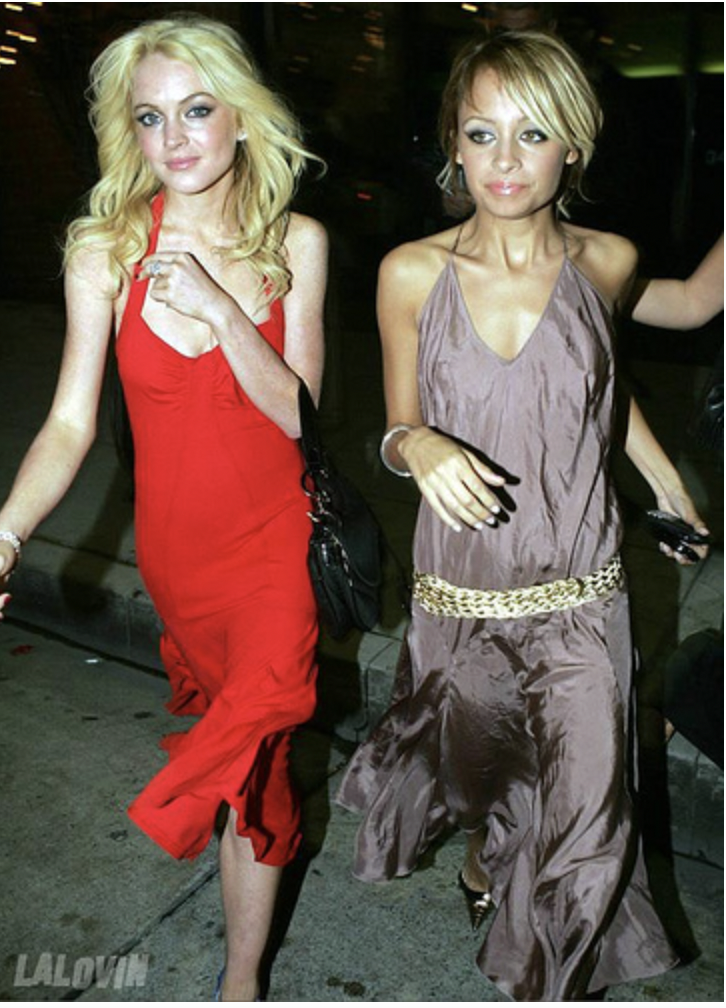
Lindsay Lohan and Nicole Richie
In the 2000s, Paris Hilton, Nicole Richie, and Lindsay Lohan dominated the cultural conversation as the paparazzi machine was finding its footing in Hollywood.
The thinness plastered all over the internet and supermarket checkout lines meant constant, inescapable awareness of a startling standard. Our it girls were living our dream lives, and thinness simultaneously became an economic aspiration and a class performance. Spend money! Live in excess! Drink your dinner! Be like Paris and Lindsay!
From Bridget Jones to Britney Spears, it wasn’t just enough to tell us what to look like; they needed to show us what NOT to look like. Not only are we dodging the body ideal, we are shamed for what our bodies looked like in that moment, making many of us turn on our own appearances.
Then we entered one of the most significant recessions in US history, and the tides started to shift. A society living on cheap meals didn't want aspirational excess held up as an ideal. The fantasy had curdled. And in that gap, something unexpected happened: the body positivity movement found its footing.
Body "Positivity" and You
For a moment, it looked like the tide had genuinely turned. Curvier models appeared on runways and the Kardashian era made volume briefly desirable. Plus-size representation at fashion week hit an all-time high of 2.4% in 2022, still an embarrassingly small number, but it was progress nonetheless.
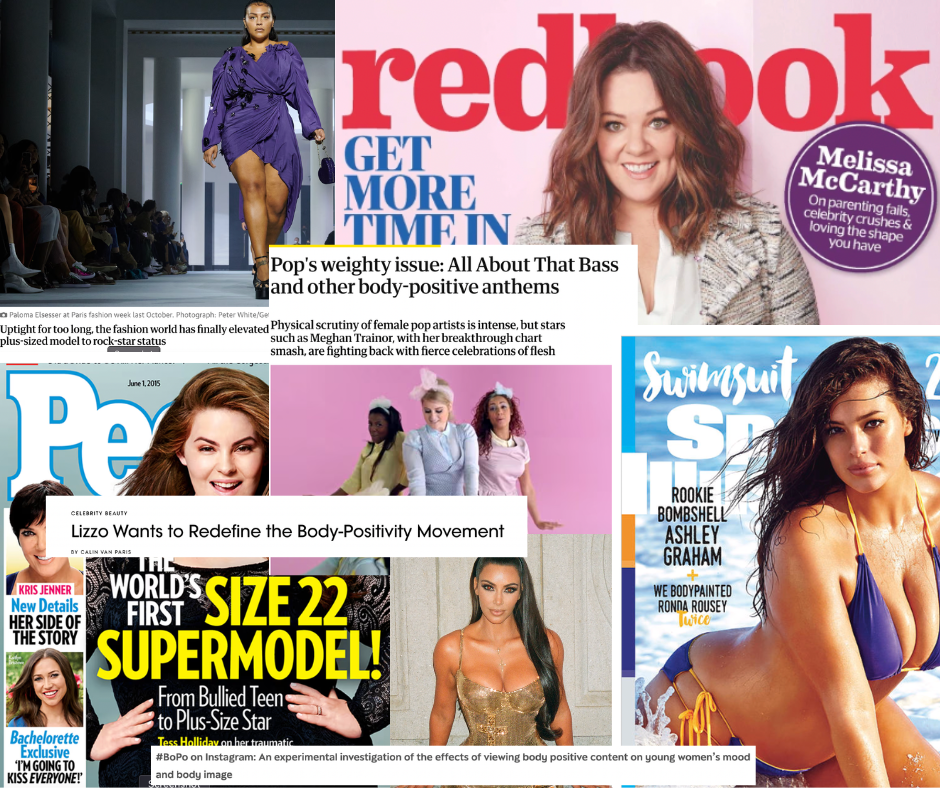
The body positivity movement had real cultural momentum. Brands started casting differently, if only slightly. The language around bodies began to shift in mainstream spaces in ways that felt, cautiously, like progress.
But here is the thing about cultural movements that don't touch industry structure: they are reversible.
According to sociologist Pierre Bourdieu, fashion operates as a field with its own internal logic, its own gatekeepers, and its own economy. Body positivity changed the conversation happening outside the field. It did not change the rules operating inside it. The casting directors, the sample sizes, the economics of producing one standard size for runway clothes, none of that changed. Which meant the moment external pressure eased, the industry simply resumed its default position.
And the pressure did ease. Budgets tightened across the industry following economic instability, and with tighter budgets came less appetite for the additional cost and effort of inclusive casting. Vogue Business reported in 2024 that the season felt like "the nail in the coffin" for size diversity on runways, with stylists noting a wholesale return to extremely thin models and near-zero representation of anyone else. The economic conditions that had briefly allowed experimentation with inclusivity dried up, and the industry contracted back to what was cheapest and most familiar.
Then came Ozempic, and whatever remained of our collective desire for "that bass" evaporated almost overnight.
Gut Health, Girl Dinner, and Other Capitalist Slop
Ozempic is a $900 to $1,300 per month (without insurance) drug that produces rapid, visible weight loss. Ozempic and other GLP-1’s did not create the desire for thinness. Rather, it monetized it at a premium price point. The body positivity movement had spent a decade trying to democratize what was considered acceptable. Ozempic re-stratified it. Thinness became, once again, something you could buy if you could afford it, a class performance with a monthly subscription fee.
But the architects of diet culture had a branding problem. A decade of body positivity discourse had made the old language toxic. You couldn't sell starvation the way you used to. You couldn't run a magazine cover calling someone fat without significant backlash. The vocabulary of the 2000s, the crash diets, the calorie counting, the open celebration of restriction, had been sufficiently discredited. So the system did what systems do when their methods become visible: it rebranded.
Enter wellness culture.
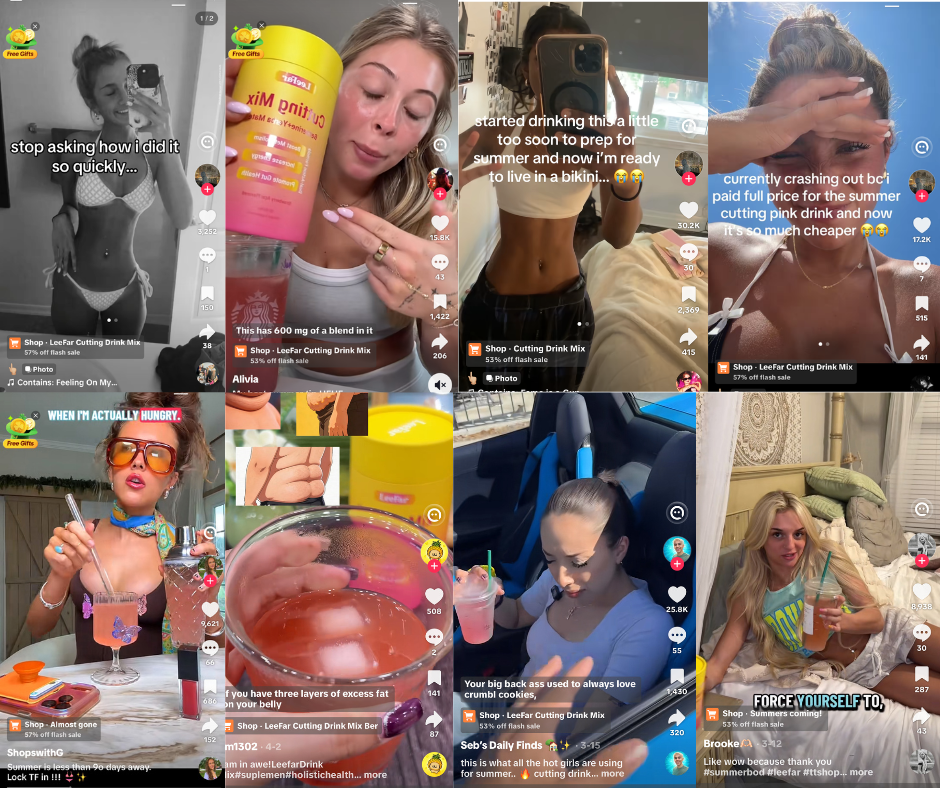
Examples of the dozens of videos promoting new cutting drink for appetite suppression.
The language evolved out of necessity. "Skinny" became "lean." "Dieting" became "eating clean." Restriction became "intuitive eating gone wrong" or a "gut reset." The fixation didn't disappear. It put on athleisure and started a podcast. Sociologist Erving Goffman's concept of impression management argued that we are all constantly performing versions of ourselves calibrated to our audience. Wellness culture is diet culture performing impression management for a post-body-positivity audience. The goal is the same, just wrapped in GymShark.
This is also where orthorexia enters the conversation. First identified in 1997 but only recently gaining clinical attention, orthorexia is an obsession with eating "correctly" rather than eating less, though the outcomes frequently overlap. A 2026 study in Acta Psychologica described it as a disorder that society actively celebrates even as it destroys people from the inside. Unlike anorexia, which carries social stigma, orthorexic behavior gets applauded.
Economically speaking, the timing is not coincidental. The global wellness industry was valued at $1.8 trillion in 2024, according to McKinsey. That market does not profit from people feeling fine as they are. It profits from the perpetual, monetizable gap between how you look and how you are told you should look. Girl dinner, gut health supplements, 75 Hard, the 30-day reset, the elimination protocol, each one is a product category built on the premise that your body, as it currently exists, is a problem requiring a solution you can purchase.
The hashtag #2000sskinnytok exists and is being used aspirationally by teenagers who were not born when the original trend peaked. TikTok has since blocked "skinnytok" as a search term, which tells you everything you need to know about what the platform understood it had become. But the content persists under adjacent tags, served by an algorithm that learned, with extraordinary precision, exactly what keeps you scrolling and exactly what insecurity to press to keep you there.
The Body Is the Indicator
Here is what the system is counting on: that you will be too tired, too hungry, and too busy optimizing your protein intake to notice that you really have no say in how your life is about to play out at all.
When economic anxiety is high, when homeownership feels like a fantasy, when bodily autonomy is legislated away and wages stagnate while everything else gets more expensive, the thin body returns as the one thing you can theoretically control. It is a pattern that has repeated across every major period of economic and political contraction in living memory. The 1990s recession gave us heroin chic. The 2000s tabloid machine sold us the it girl and then publicly destroyed her. The 2008 collapse briefly loosened the grip. Nearly two decades later, in an era of normalized scarcity and continuous low-grade crisis, it tightened again.
None of this is your fault. Not the Google search about losing twenty pounds by May or the flat tummy tea you bought. Not the Pinterest board thinspo or the cutting drink in your cart that will help you skip lunch and dinner. You are a survivor of a system that wants to keep us thin and easy to control.
Our favorite singers, our rights, our economic possibilities are all shrinking, and the industry that profits from all three is asking you to shrink along with them.
Don't.
REFERENCES
Bourdieu, Pierre. The Field of Cultural Production. Columbia University Press, 1993.
Fashion Dive. "Plus Size: Not a Trend." June 2025. https://www.fashiondive.com/news/plus-size-not-a-trend/750017/
Goffman, Erving. The Presentation of Self in Everyday Life. Anchor Books, 1959.
Gramsci, Antonio. Selections from the Prison Notebooks. International Publishers, 1971.
Hannum, Randall. "Recession of 1990-1991." EBSCO Research Starters, 2022. https://www.ebsco.com/research-starters/history/recession-1990-1991
Orbach, Susie. Fat is a Feminist Issue. Paddington Press, 1978.
Wolf, Naomi. The Beauty Myth: How Images of Beauty Are Used Against Women. William Morrow, 1991.