
The Dixie Chicks Made Me Liberal: A History of Female Celebrities Punished for Their Politics
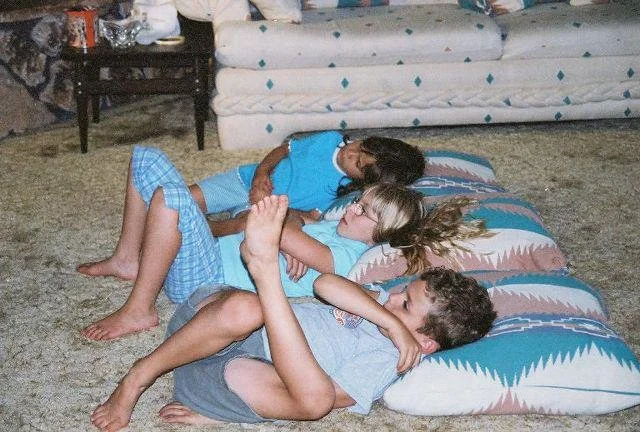
Me and My Siblings, 2001, New Mexico, Locked in on CMT Country Music Videos.
I was raised by active-duty Air Force members, both Southern, which meant Saturday mornings sounded like Shania Twain, Garth Brooks, and most notably, my girls, the Chicks. (Formerly The Dixie Chicks.)
Their music made me feel empowered, like I, too, could pack up and leave, like staying small wasn't required, like there were wide open spaces somewhere with my name on them. My parents had strict rules and a general Republican aura, but our house was inundated with powerful women making powerful music anyway. The Chicks were the loudest of them.
And they were everywhere. By the time I memorized their lyrics, the Chicks were the best-selling female group in any genre in American music history. Two diamond albums in a row, a feat no other female group of any genre had ever matched. In 1998, they outsold every other country group combined. By 2002, Home was triple platinum two months after release, with thirteen Grammys on the shelf and “Travelin' Soldier" sitting at their sixth number one. They were halfway through an arena tour called Top of the World.
That was, until 9/11 and Operation Iraqi Freedom. Until Natalie Maines used her voice to speak out.
Candidly, I was not sentient enough to know anything about the Chicks outside of their music back then. All I knew was that the radio that carried them every Saturday morning had quietly stopped, and the CDs were abruptly left out of our cleaning days. Something had shifted.
Not Ready to Sacrifice Her Voice
Back in early 2003, the Chicks were halfway around the world, headlining a sold-out show at London's Shepherd's Bush Empire. They were nine days from the U.S. invasion of Iraq. Most of America was still draped in the post-9/11 flag, and the Bush administration was finishing the war's PR rollout. The Chicks were on the second leg of the Top of the World Tour, and Natalie Maines was about to introduce "Travelin' Soldier," a song about a high school girl losing her boyfriend in Vietnam.
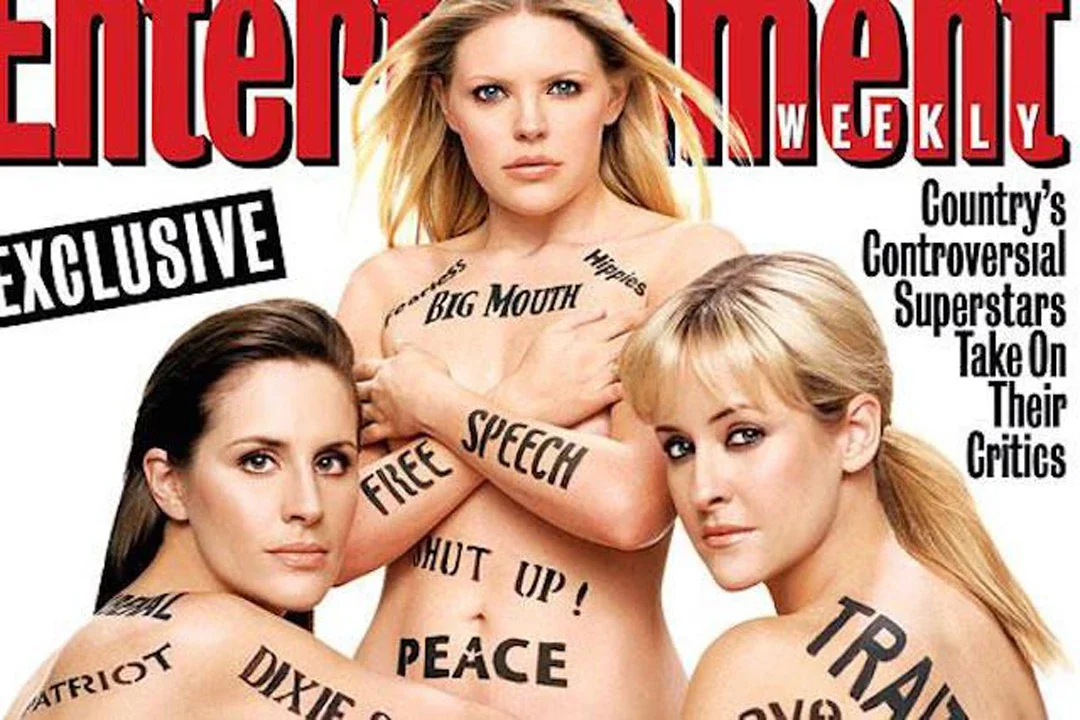
“Just so you know,
we're on the good side with y'all. We do not want this war, this violence, and we're ashamed that the President of the United States is from Texas.
- Natalie Maines, 2003
The Guardian printed it the next day. Cumulus Media, which owned 42 country stations, banned the Chicks across all of them by sundown. Other broadcasters followed within 48 hours. "Landslide," sitting at #10 on the country chart, fell to #43 in a single week. Some stations organized public album-destruction events, where listeners drove tractors over their Chicks CDs live on air. Toby Keith began performing in front of a doctored backdrop that pasted Maines's face beside Saddam Hussein's. Then the death threats started.
Back in the 1970s, Stanley Cohen coined the term moral panic, which succinctly describes the hyper-patriotism of the early '00s. Basically, a moral panic happens when a person or group is suddenly recoded as a threat to societal values, and the institutional response wildly exceeds the actual offense. The 2003 backlash wasn't a market correction, nor was it free speech being met with more free speech. Post-9/11 America had stockpiled a great deal of unprocessed nationalist anxiety, and Maines, a twenty-eight-year-old woman in a country band, gave people a way to discharge it.
What's particularly interesting is how political opinions were received along gender lines back then. Merle Haggard, the genre's elder statesman, released an explicitly anti-war song called "America First" that same summer. Country radio kept playing him. Willie Nelson was floating 9/11 conspiracy theories in interviews around the same time. Country radio kept playing him, too. The genre could metabolize a great deal. For some strange and unknown reason, it could not metabolize three women who said the war was bad.
By late spring 2003, the wreckage had a tacky and borderline misogynistic name: "Dixie Chicked." It meant career destruction by political speech, and it served as a warning to other women in entertainment: this is what happens when you exercise freedom of speech. The most successful female group in any genre in American music history had been removed from the format that built them in less than three weeks. You are no more special than they are.
It was the first time we'd seen political backlash at this speed, with this shape, on this scale. It would not be the last.
From Franchise Lead to Slashed in 7 Days
Twenty years later, it was Melissa Barrera. She was thirty-three, a Mexican-American actor leading the Scream franchise reboot, with the seventh installment in the works. By most industry metrics, she was on the rise. Then, in October 2023, the war in Gaza began, and Barrera did what a great many celebrities did in those first weeks: she posted about it on Instagram.
For the record, all she posted was calls for a ceasefire and shared links to fundraising drives for Palestinian humanitarian aid. By late November, hundreds of public figures were posting similar content, and a coalition of artists had organized into a group called Artists for Ceasefire, with a public letter signed by, among others, Jon Stewart, Jordan Peele, America Ferrera, and Javier Bardem.
On November 21, 2023, Spyglass Media Group fired Barrera from Scream 7.
“We have zero tolerance for antisemitism or the incitement of hate in any form, including false references to genocide, ethnic cleansing, Holocaust distortion or anything that flagrantly crosses the line into hate speech.”
Within days, William Morris Endeavor dropped her as a client. Her co-star Jenna Ortega exited the project shortly after, reportedly over scheduling conflicts. The franchise that had built itself around Barrera and Ortega's chemistry now had neither star to head their movie.
The ceasefire letter she had aligned with had hundreds of signatories. The men named alongside her continued working virtually untouched. Bardem, who had been vocally pro-Palestine for years, was booked just as often as he had been prior, if not more. So were Stewart and Peele and the rest.
Spyglass did not argue with what Barrera had said. They did not engage the substance of the Holocaust scholarship she had reshared, or the long-running debate among historians and human rights organizations about what to call what was happening in Gaza. They labeled her a source of hate, and they attempted to blacklist her for it.
Unfortunately, Barrera wouldn't be the only woman in Hollywood to face backlash for this. The same week she was fired from Scream 7, Susan Sarandon was dropped by the United Talent Agency after nine years as a client. Sarandon, an Oscar winner with a fifty-year career, had attended a pro-Palestine rally in New York and made a contested statement about American Muslims and Jews, which she later apologized for.
“It became impossible for me to even be on television. I couldn’t do any major film or anything connected with Hollywood.”
Two years later, Kate Beckinsale liked a post calling for a ceasefire and was dropped by her agency after more than a decade. Mark Ruffalo, Beckinsale's male peer at the same agency, had been publicly, vocally pro-Palestine for years, and continued working.
Three women. Three different industries inside the entertainment ecosystem. Three different career stages: a rising lead, an institutional icon, and an established veteran. All three were exiled for using their platforms to speak about peace and the violence taking place in Gaza.
For the women watching, the lesson was made as clear today as it was back in 2003: Keep your mouth shut, keep performing, and don't rock the boat. Or else.
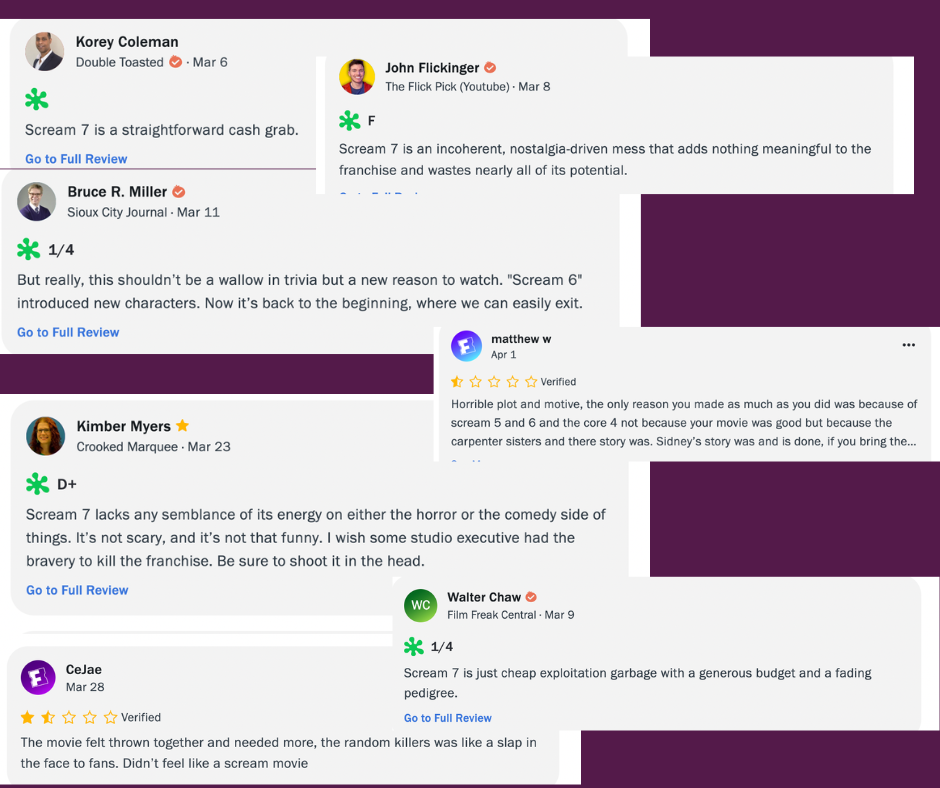
The Scream franchise made it to theaters without her, on what she correctly called nostalgia bait. Spyglass attempted, and failed, to replace the raw chemistry and charisma that Barrera and Ortega brought to the franchise. Scream 7 is the franchise's lowest-rated film to date.
The question I am forced to ask is: why is it predominantly women who face the harshest backlash for expressing their political opinions? And why are there male outliers who also face the consequences, less severe or otherwise?
Spoiler alert: the answer is mostly sexism and racism! (Who would've guessed?)
The "Exceptions" to the Rule
The pattern is not absolute, and the argument has never been that no man has ever lost a job for a political opinion. But when men are punished, the experience tends to follow a different shape.
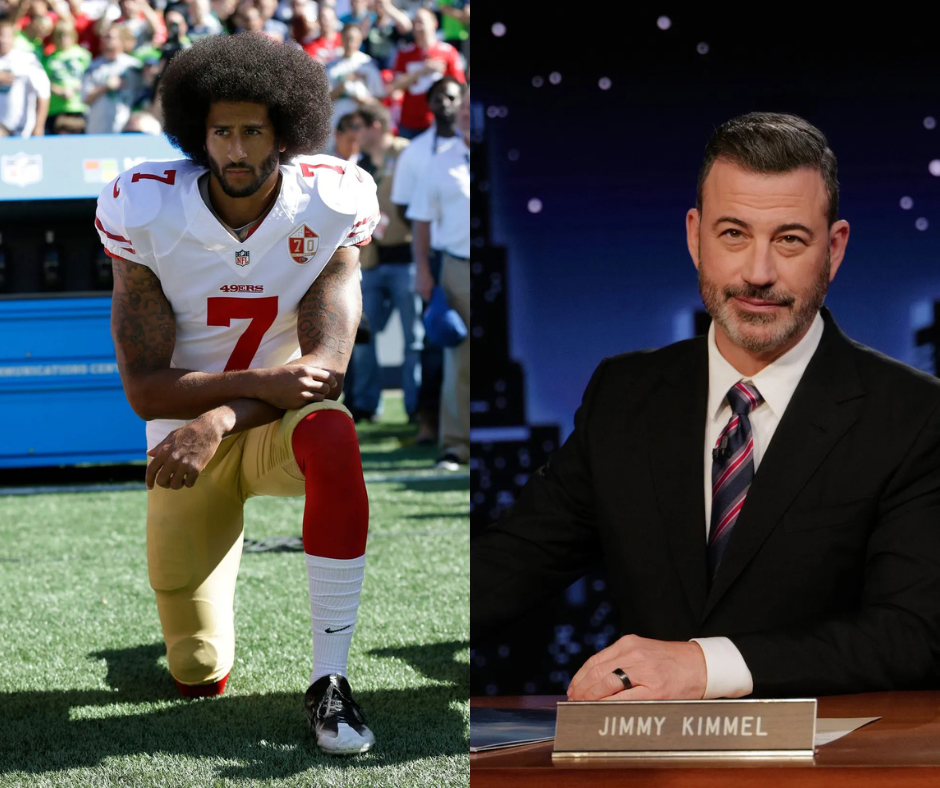
On September 17, 2025, ABC pulled Jimmy Kimmel's late-night show off the air indefinitely after he made a monologue connecting the rhetoric of the MAGA movement to the assassination of Charlie Kirk.
The FCC chair, Brendan Carr, threatened licensing action against affiliates that aired the show. Nexstar and Sinclair, two of the largest broadcast affiliate groups in the country, dropped Kimmel from their stations. By any reasonable measure, this was a coordinated institutional action against a major figure for political speech.
Within twenty-four hours, the defense apparatus arrived. SAG-AFTRA, the Musicians Union, the ACLU, and FIRE all made public statements denouncing the decision. Lawmakers from both parties, including several Republicans, condemned the suspension as government overreach. Hundreds of protesters showed up outside Disney's Burbank offices. Five days after the suspension, Kimmel was back on the air. His career, his salary, his platform, and his cultural standing were unbroken.
The most significant male case on modern record is Colin Kaepernick. The variable in his case is not, primarily, his gender. Rather, it is his race, and the racial politics of the protest itself. In 2016, Kaepernick took a knee during the national anthem to protest police violence against Black Americans. He was effectively blacklisted from the NFL after that season. He settled a collusion grievance against the league in 2019 and has not played in the league since. By the bare measure of careers destroyed, Kaepernick's punishment is more severe and more lasting than Kimmel's.
But something more intriguing happened after his football career was threatened. Nike signed him as a brand spokesperson. Sports Illustrated gave him the 2018 Muhammad Ali Legacy Award. His cultural stature grew as his athletic career disappeared. He was punished by an institution and elevated by the culture. That dual movement is the activation of what sociologists call cultural capital, the kind of social currency that buffers a punished man even when his institution turns on him. It is the part of the male experience of punishment that women, particularly women of color, seldom receive.
The lesson I'm taking from these situations is this: when men are punished, the institutions of professional defense activate within hours, and the punishment tends to end in days. When women are punished, those institutions do not activate, and the punishment does not end. Punishment for political speech is not gender-blind, and it is not race-blind. The institutional response and the cultural response do not move in unison. For men with platforms, particularly white men, the cultural defense tends to keep pace with the institutional damage. For women, and for Black men whose protests challenge state power directly, the cultural defense often arrives late, or not at all.
The Women Who Made Me Outspoken
The system is functioning exactly as designed, exactly as it always has and always will. It identifies women with platforms who say things their industries find inconvenient, and it removes them. The mechanism predates the platforms and the algorithms and the contemporary debates about cancel culture.
It did not begin with the Chicks. Eartha Kitt was blacklisted for a decade after speaking against Vietnam at a White House luncheon in 1968. Jane Fonda is still public enemy #1 to anyone’s grandpa after her tireless protest of the Vietnam War. Sinéad O'Connor was destroyed by an institution whose abuses she was later vindicated for naming.
The Chicks made me liberal by showing me what gets done to women who refuse to keep the peace. They taught me that what made country radio safe for women was to agree to be small, and that the ones who refused to be small were the ones that I needed to pay attention to. Melissa Barrera reminded me of that twenty years later. The harder they try to muzzle us, the more obvious it is who is afraid of whom.
Sorry, Mom and Dad! If you wanted me to be docile, maybe you should’ve played less “Goodbye Earl” and more of Kenny G’s greatest.
—
References
Bourdieu, Pierre. "The Forms of Capital." In Handbook of Theory and Research for the Sociology of Education, edited by John G. Richardson, 241–58. Greenwood, 1986. (Foundational text on cultural capital, referenced in Section IV.)
Cohen, Stanley. Folk Devils and Moral Panics: The Creation of the Mods and Rockers. MacGibbon and Kee, 1972. (Foundational text on moral panic, named in Section II.)
"Eartha Kitt Goes to Washington." White House Historical Association. https://www.whitehousehistory.org/eartha-kitt-goes-to-washington
Kopple, Barbara, and Cecilia Peck, dirs. Dixie Chicks: Shut Up and Sing. The Weinstein Company, 2006.
Reilly, Nick. "Susan Sarandon: Banned From Hollywood After Gaza Ceasefire Comments." The Hollywood Reporter, March 2026. https://www.hollywoodreporter.com/news/general-news/susan-sarandon-banned-hollywood-gaza-ceasefire-comments-1236518699/
"Transcript of Colin Kaepernick's Comments About Sitting During National Anthem." ESPN, August 28, 2016. https://www.espn.com/blog/san-francisco-49ers/post/_/id/18957/transcript-of-colin-kaepernicks-comments-about-sitting-during-national-anthem
Vary, Adam B. "Melissa Barrera Was Canceled by Hollywood for Speaking Out Against Israel. She's Still Fighting Her Way Back." Variety, May 2026. https://variety.com/2026/theater/actors/melissa-barrera-canceled-israel-palestine-scream-7-titanique-1236738358/
Vary, Adam B. "Spyglass Says Melissa Barrera Was Fired From 'Scream' Due to Rhetoric That 'Flagrantly Crosses the Line Into Hate Speech.'" Variety, November 22, 2023. https://variety.com/2023/film/news/scream-producers-explain-melissa-barrera-fired-antisemitism-1235804914/